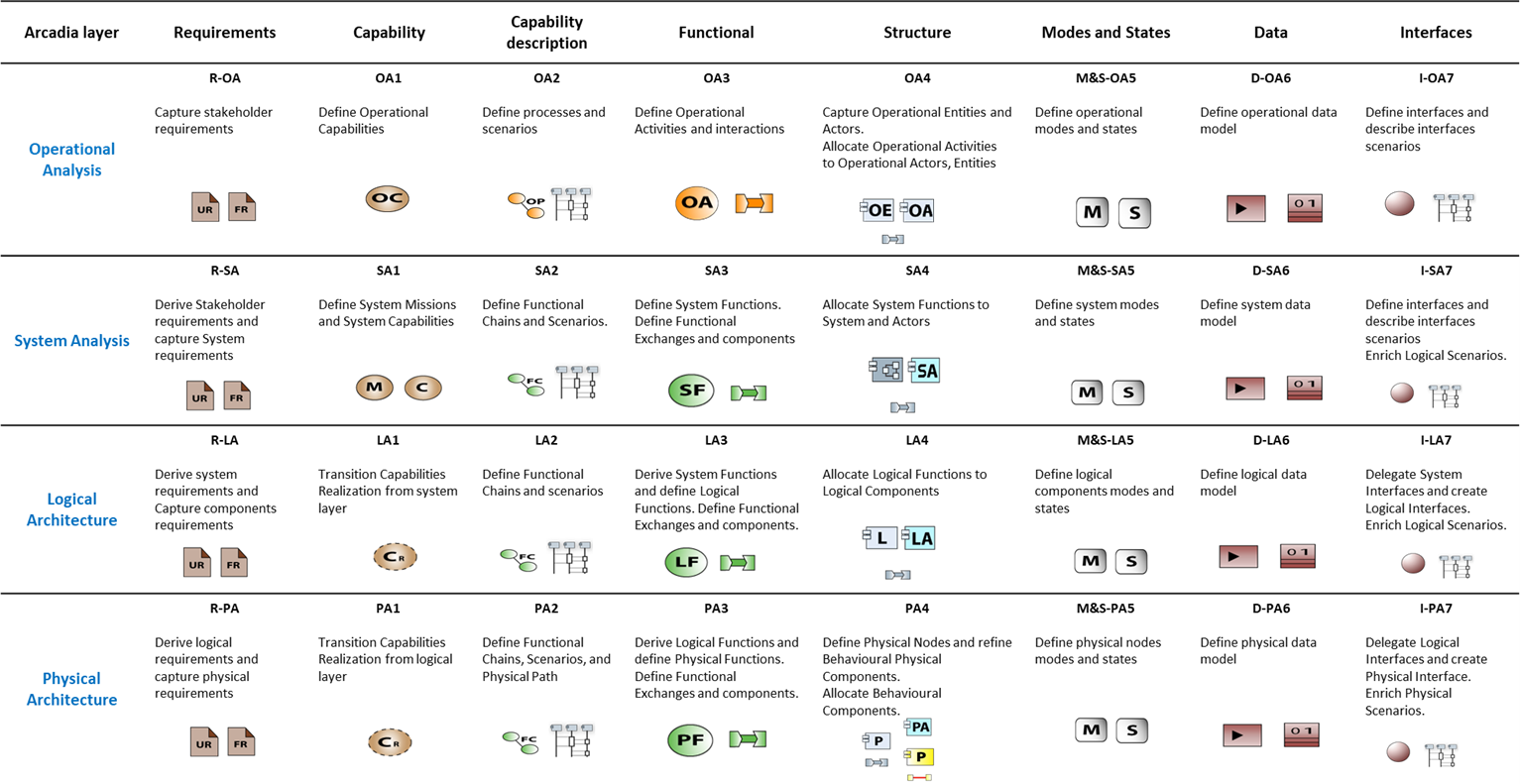
Arcadia is a tooled method devoted to systems & architecture engineering, supported by Capella modelling tool.
It describes the detailed reasoning to
It can be applied to complex systems, equipment, software or hardware architecture definition, especially those dealing with strong constraints to be reconciled (cost, performance, safety, security, reuse, consumption, weight…).
It is intended to be used by most stakeholders in system/product/software or hardware definition and IVVQ as their common engineering reference and collaboration support.
Arcadia stands for ARChitecture Analysis and Design Integrated Approach.
A series of online documents to dive into the principles and concepts of Arcadia:
Arcadia is a system engineering method based on the use of models, with a focus on the collaborative definition, evaluation and exploitation of its architecture.
This book describes the fundamentals of the method and its contribution to engineering issues such as requirements management, product line, system supervision, and integration, verification and validation (IVV). It provides a reference for the modeling language defined by Arcadia.
Jean-Luc Voirin, leader of the creation of the Arcadia method, along with some of the leaders on developing and deploying MBSE Arcadia & Capella practices in Thales. From right to left: Pierre Nowodzienski, Jean-Luc Voirin, Juan Navas, Stephane Bonnet, Frederic Maraux, Gerald Garcia, Philippe Fournies, Eric Lepicier.
Architecture as prime engineering driver
Arcadia, a model-based engineering method
Noticeable features of Arcadia
Definition of the Problem - Customer Operational Need Analysis
Formalization of system requirements - System Need Analysis
Development of System Architectural Design - Logical Architecture (Notional Solution)
Development of System Architecture - Physical Architecture
Formalize Components Requirements - Contracts for Development and IVVQ
Co-Engineering, Sub-Contracting and Multi-Level Engineering
Adaptation of Arcadia to Dedicated Domains, Contexts, Etc.
Equivalences and Differences between SysML and Arcadia/Capella
While there is no official industry term "patched" for carburetor diagrams, it typically refers to a often shared in enthusiast forums to address common issues like vacuum leaks or "unidentifiable" ports. Key Components of the Mikuni BS25
The precise inner diameter engineered to balance maximum airflow velocity with immediate throttle response.
For further assistance, you may want to consult: mikuni bs25 carburetor diagram patched
The float tang needs adjustment (usually to 13–15mm, depending on model) to stop flooding. 3. Step-by-Step Restoration Procedure Follow this guide to rebuild and "patch" your Mikuni BS25: Step 1: Disassembly and Inspection
Tell you (e.g., sonic cleaner, specific jet tools). Explain how to check for vacuum leaks after installation. While there is no official industry term "patched"
For larger tears, cut a tiny circle out of a thin nitrile glove. Use a light smear of flexible adhesive to glue it over the tear like a tire patch.
Before using any diagram, it's essential to understand the major components of the Mikuni BS25. This carburetor is a diaphragm (or vacuum) type unit, which uses engine vacuum to lift the slide rather than a direct mechanical linkage. For larger tears, cut a tiny circle out
Allow the patch to cure completely for at least 4 to 12 hours before exposing it to gasoline vapors.
Works as a mechanical fluid-level shutoff. It ensures the fuel reservoir inside the bowl stays at a fixed height relative to the jets.
After repairing or patching the carburetor, you must tune it.